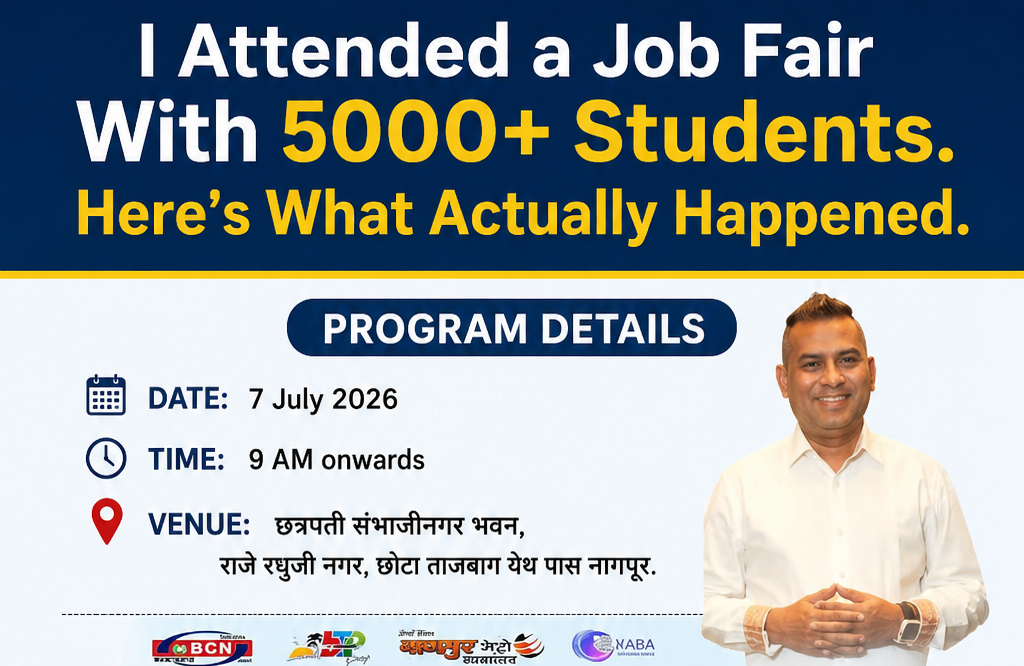
A few weeks into my job search, I heard about Kamgar Melava — a large job fair in Nagpur with dozens of companies participating. I registered, printed extra copies of my resume, and showed up early. I was expecting something like what job fairs look like in career brochures: company booths, HR conversations, maybe a spot interview or two.
What I found was different. Here's what actually happened — and what I think freshers should know before attending one of these.
The scale was overwhelming — and that was the first problem
I didn't expect 5000+ students. The venue was packed from the moment the gates opened. Long queues at every company booth, hundreds of people moving between stalls, noise levels that made conversation difficult.
In theory, scale is good — more companies, more opportunities. In practice, scale at a job fair means every company representative is managing an impossible number of interactions simultaneously. Nobody has time to actually talk to you. The conversation at most booths lasted under two minutes.
What companies were actually doing there
Most companies at the fair were doing one thing: collecting resumes and registering candidates in their systems. That's it.
There were no spot interviews at the booths I visited. No technical conversations. No "tell me about a project you've worked on." The interaction was: hand over resume, give your phone number, sometimes fill a Google Form on a tablet they held out. Then move on.
I understand why companies do this — a job fair is an efficient way to build a candidate database. But it's worth being honest about what that means for attendees: you are being added to a list. Whether anyone from that list gets called depends on factors you have no visibility into and no control over once you've walked away from the booth.
The HR teams were trying — but they were outnumbered
I want to be fair here. The HR representatives I spoke to weren't dismissive or rude — they were simply overwhelmed. When one person is managing a queue of 50+ candidates with more arriving every minute, meaningful conversation isn't possible. That's not a criticism of the people; it's a structural problem with how large job fairs work.
A few booths were better organized — they had multiple team members, clear role descriptions displayed, and a slightly more structured intake process. Those were the booths worth spending more time at, even if the conversation was still brief.
5000+ students, and the math that doesn't work in your favor
Let's say 30 companies attended. Let's say each company is hiring for 5 positions. That's 150 positions, and 5000+ candidates. Even if every company only collected resumes from half the attendees, each position has roughly 16 candidates competing for it — from a single job fair, in a single city, on a single day.
That math doesn't include online applicants, referrals, internal candidates, or the fact that many companies attend job fairs to build a talent pool for future roles that may or may not exist yet.
I'm not saying this to be discouraging. I'm saying it because understanding the actual odds helps you allocate your effort correctly. A job fair is one channel, not the channel.
It has been over a week. I haven't received a call.
I submitted my resume at multiple booths. I filled forms. I had brief conversations with HR representatives who seemed genuinely interested. I followed up where I had contact details.
So far: no calls, no emails, no acknowledgment that my resume was received. That might change — job fair pipelines can take weeks to process — but it's also entirely possible that nothing comes from it.
I'm not surprised, exactly. But I am more clear-eyed about what job fairs actually are than I was before I attended one.
What I'd do differently next time
Go with lower expectations and a clearer strategy. Specifically:
- Research companies before going. Don't walk in and see which booths look interesting. Know exactly which 3-5 companies you want to talk to, what roles they're hiring for, and one specific thing about each company that you can reference in the conversation. Standing out in a 90-second interaction requires preparation.
- Treat it as a network-building exercise, not a hiring event. The goal isn't to get hired on the day. The goal is to make a memorable enough impression that when they're processing resumes later, yours comes with a face and a conversation attached.
- Get direct contact details. "Can I have a business card or an email address to follow up?" is a reasonable question. Some will say no. Some will give you something useful. A direct email to the HR person you spoke to is worth ten cold applications through a portal.
- Bring a portfolio link, not just a resume. If you have a GitHub profile, a live project, a blog — anything that can be seen rather than just read — mention it and make sure it's on the resume prominently. In a pile of identical-looking resumes, a link to something real stands out.
What job fairs are actually good for
I don't want to conclude that job fairs are a waste of time — they're not. But they're not what the name implies either.
What a large job fair is genuinely good for:
- Getting a sense of which companies are actively hiring in your city and in your field — which is useful market intelligence even if you don't get hired from the fair itself.
- Practicing how you present yourself in brief, high-pressure interactions. If you're nervous talking to strangers about your skills, a job fair is a low-stakes place to practice that — the individual interaction doesn't matter much, which means you can afford to treat it as practice.
- Getting your resume in front of companies you might not have found online — some companies hire primarily through offline channels, and job fairs are how you find them.
The honest summary
I went to a job fair with 5000+ other students. Most companies were there to collect resumes and register candidates, not to interview or hire on the spot. I haven't received a call yet, and I might not — that's the realistic outcome for most attendees.
What it gave me: clarity about what job fairs actually are, a few direct contacts I've followed up with, and a better sense of which companies are actively recruiting in Nagpur right now.
Is that worth a day's time? Probably. Is it the job search strategy I'd rely on? No. It's one input in a process that requires many.
Keep applying through multiple channels. Don't wait for a job fair callback before pursuing other opportunities. And if you're planning to attend one — go prepared, go with realistic expectations, and treat every brief conversation as practice rather than a make-or-break moment.