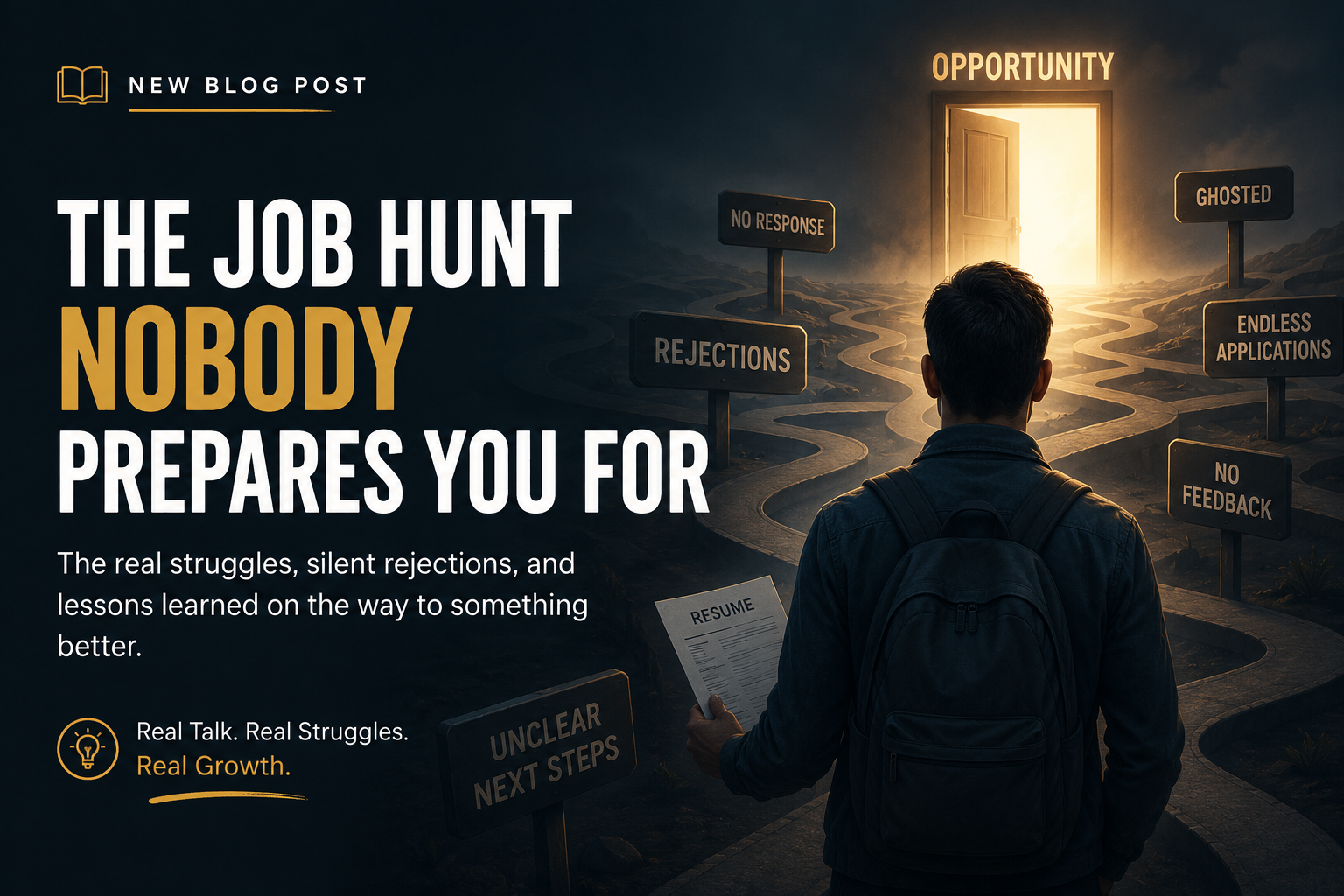
Before I started applying, I had a clear picture of how the job hunt would go. Build a good resume, apply to relevant companies, get interviews, get an offer. Linear. Manageable. A process with a beginning and an end.
That picture was wrong in almost every detail. Here's what it actually looks like from the inside — the parts nobody puts in a career advice article because they're not motivational enough.
Most of it is noise management
When you start applying as a fresher, you get two kinds of responses: silence, and things that look like opportunities but aren't. The silence is from the real companies. The fake opportunities are from everyone else.
Within the first two weeks, I had received: three offers from companies that wanted registration fees, two calls from "recruiters" who couldn't name the company they were hiring for, one Google Form "assessment" from a company whose website had been registered 30 days ago, and zero responses from the roles I actually wanted.
Managing this noise — staying skeptical without becoming cynical, staying motivated without chasing things that aren't real — is a skill nobody teaches you. You develop it by getting burned a few times and learning to recognize patterns.
Cold outreach works differently than portals
Job portals (Naukri, LinkedIn, Internshala) are the obvious starting point, and they're worth using. But the hit rate is low — you're competing with hundreds of applicants for every posting, and your application is processed by an ATS before a human ever sees it.
Cold emailing HR contacts directly felt uncomfortable at first — like I was skipping a queue I wasn't supposed to skip. But a short, specific email to an actual person gets read differently than application #847 in a portal queue. It's not about being pushy. It's about making contact before the formal process filters you out.
What works in cold outreach: being specific about the role, referencing something real about the company, attaching a resume that's already tailored to them, and keeping the email under 150 words. What doesn't work: generic templates, "I am interested in any available opportunities," and following up three times in one week.
The assignments you do for companies that don't hire you
Several companies I applied to sent take-home assignments as part of their process. I completed all of them — a QA testing document and QMS workflow presentation for one company, a Python trading bot CLI and a full-stack JWT/RBAC REST API for another, a pipeline automation CLI for a third.
Some of those companies moved forward. Some went silent after I submitted. One sent feedback; most didn't.
I used to find this demoralizing. I still find it frustrating. But I've reframed how I think about it: every assignment I completed taught me something I didn't know before I started. The trading bot taught me about CLI design. The REST API taught me about JWT authentication and RBAC. The pipeline tool taught me about automation workflows.
The company that didn't hire me still gave me something useful. That's not a consolation — it's genuinely how I think about it now.
Preparing for interviews you might not get
I've spent hours preparing structured answers for Python fundamentals, Flask internals, REST API design, manual testing concepts, and system design basics — for interviews that sometimes never happened. The company paused hiring. The role got filled internally. The recruiter stopped responding.
Early on, that prep felt wasted. Now I think of it differently: interview preparation is not for the specific interview. It's for the cumulative skill level that improves with every round of prep. The person who prepared for ten interviews that got cancelled is sharper in the eleventh interview than the person who only prepared once.
The pressure to take the first thing that says yes
This is the one nobody talks about. After enough silence and enough rejections, something shifts. You start looking at offers differently — not "is this a good opportunity" but "at least someone said yes."
I've felt that pressure. I've also seen what happens when people give in to it — taking roles that pay below market, at companies with unclear job descriptions, under managers who don't communicate clearly. The pressure is real. So is the cost of acting on it too quickly.
What helped me was building things in parallel. Every week I spent applying, I also spent time on a project — something real that was moving forward even when applications weren't. It kept the job hunt from being the only thing that defined progress.
What's actually helped
Not a framework, not a tool, not a specific strategy — just a few things that made a consistent difference:
- Verifying every offer before getting excited about it. WHOIS lookup, LinkedIn check, address verify. Ten minutes before celebrating saves a lot of regret.
- Treating rejections as data. Not verdicts on whether I'm good enough — data about what this specific company was looking for, which is not the same thing.
- Building in public. This blog is part of that. Documenting what I'm working on keeps me accountable and gives interviewers something to look at beyond a resume.
- Staying specific. "I want a software development role" is too broad to prepare for. "I want a Python backend role where I can work with APIs and databases" is something I can actually prepare for, apply to specifically, and talk about confidently.
If you're in the middle of this right now: the waiting is normal. The noise is normal. The pressure to take anything is normal too — just don't act on it faster than the situation actually requires.
Keep building. Keep applying. Document what you're learning. It compounds.